Communication Development Strategies for Children with Autism
Try practical ways to support communication through clear language, meaningful choices, gestures, pictures, AAC, and everyday routines.

Communication happens when a child asks for help, shares something interesting, says no, or lets someone know that something hurts. Spoken words can be part of that exchange, alongside gestures, signs, pictures, writing, and augmentative and alternative communication (AAC).
Useful communication development strategies make everyday interactions easier to understand and participate in. Rather than setting aside the whole day for practice, choose a few routines where your child already has something meaningful to say.
Identify the message before choosing a strategy
Begin by noticing what your child communicates successfully and where misunderstandings occur. A child may request favorite items easily but need support to ask a question, report a problem, or tell someone to stop.
Notice whether noise, long directions, or unfamiliar phrases make understanding harder. Adults can adjust how they communicate.
For children who need assessment, an SLP can help identify receptive language needs, expressive communication needs, and suitable supports. ASHA emphasizes individualized assessment and intervention for autistic people. [1]
Follow an interest your child enjoys
Join an activity your child has chosen. If the child is looking at a toy train, comment on what the train is doing rather than redirecting the interaction to an unrelated question.
Say “Train goes” and roll another train nearby. Respond to the child's message through words, pictures, or AAC.
Autism Spectrum Australia's guidance describes following the person's interests, modeling language, and building communication into daily routines as useful approaches. [2] Keep the exchange flexible; a child can communicate interest without playing exactly as an adult expects.
Make your own message easier to understand
Use language that fits the situation and the child's current understanding. Instead of “Could you please get everything organized before we head out,” try “Shoes on,” with a relevant gesture or visual cue if helpful.
Give one instruction, then time to respond. If it is not understood, show or explain it differently instead of simply repeating the same sentence more loudly. ASHA recommends manageable directions and reduced distractions when needed for communication tasks. [3]
Ask the SLP how to support the languages your family uses.
Add language without demanding repetition
Model a short message connected to what your child has communicated. If the child points toward a window, you might say, “Bird outside.” If they say “car,” you might respond, “Red car.” An AAC user may benefit from seeing an adult model a relevant selection on their system.
Let your child respond in their own way. Avoid repeated testing questions or demands to copy each model.
Ask the SLP how much language to model.
Offer real choices and honor the response
Use choices that are genuinely available. Hold up two books or show their pictures and ask which one your child wants. Accept a clear selection made through speech, reaching, pointing, or the child's established communication system.
Allow “different,” “stop,” or “not now.” The child's response needs to affect what happens next.
Keep essential needs and communication tools accessible. Practice should not require creating unnecessary distress or withholding something the child needs.
Make room for more than requesting
Choose a routine and consider messages beyond requesting, including comments, questions, and disagreement.
During a walk, you might pause to notice a dog, respond to your child's reaction, and offer a way to say “farther away” if the child is uncomfortable. During reading, your child might choose a page, comment “funny,” or say “finished.”
Choose vocabulary that reflects the child's interests and access needs.
Practice repairing misunderstandings
When you do not understand, acknowledge the attempt and offer another route. You might say, “I missed that. Can you show me?” or ask a question the child can answer reliably.
Check your interpretation. If the child points toward a cupboard, offer relevant picture or AAC choices without physically directing the answer.
Model repair yourself: “I meant the blue bag.”
Choose one routine and review what changes
Choose a small goal, such as asking for help during play. Notice independent communication and how comfortable the interaction feels.
With your consent, the SLP, teacher, and ABA provider can share observations and coordinate relevant communication goals.
Visit Early Autism Services to ask your local team about individualized ABA support for everyday communication and participation. Speech-language evaluation can help guide language and AAC needs.
Frequently asked questions
Are these strategies only for children who do not speak?
No. A child who uses spoken language may still benefit from clearer directions, processing time, or support with expressing needs and repairing misunderstandings.
How much practice should I add each day?
Begin with one or two enjoyable routines. Ask the child's team how to keep practice manageable and responsive to the child's needs.
What if my child communicates differently at home and school?
Compare communication partners, available tools, noise, and task demands. Share successful supports so the team can identify what helps in each setting.
Related reading
- Supporting Communication Development Through ABA Therapy
- How Parents, Teachers, and Therapists Can Work Together
Sources
[1] ASHA Practice Portal — Autism and Autism Spectrum Disorder.
[2] Autism Spectrum Australia — Supporting communication.
[3] ASHA — Supporting a Child Who Has a Communication Disorder.
Explore More
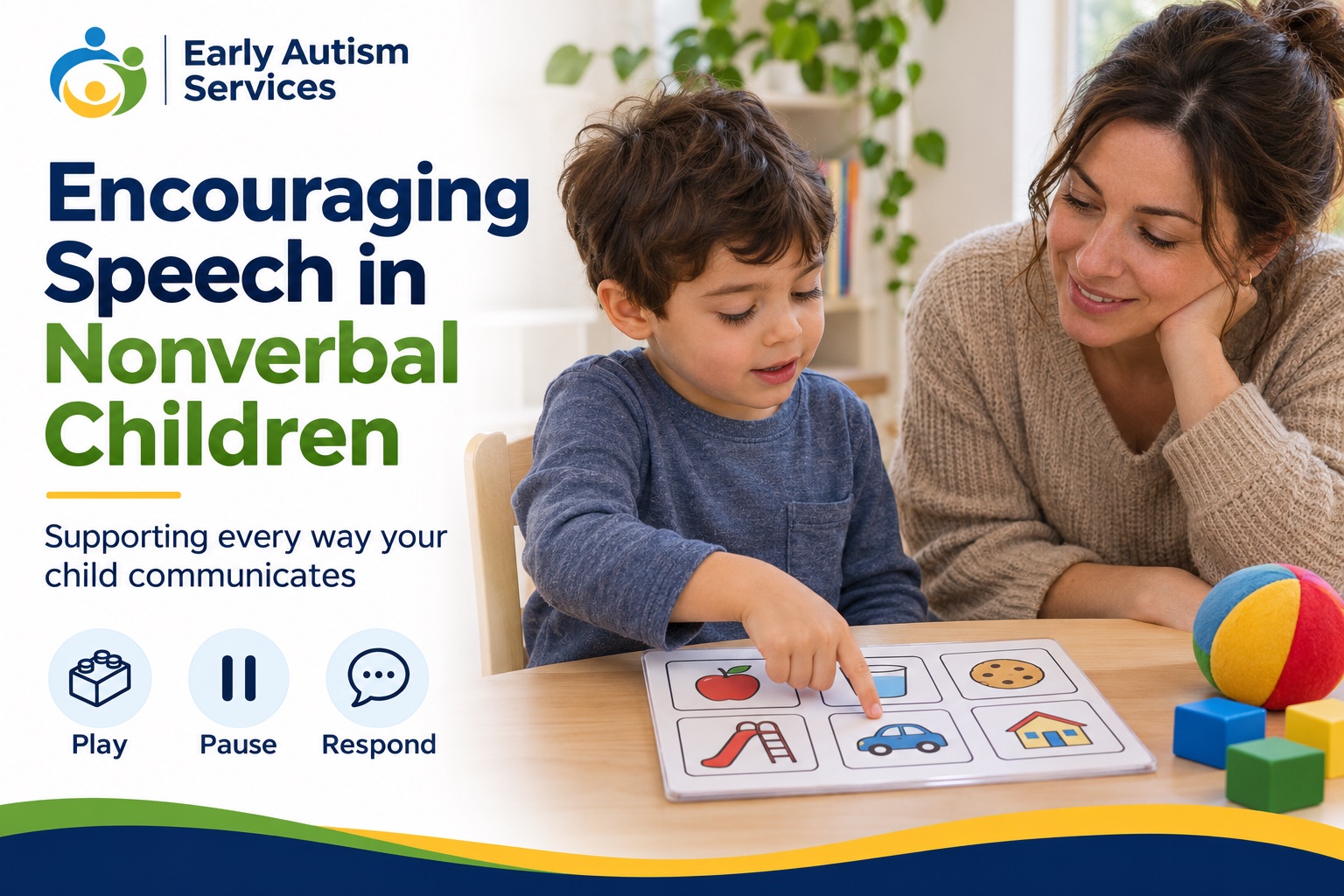
Encouraging Speech in Nonverbal Children
When a child uses few or no spoken words, parents often want to know what they can do to help. Encouraging speech in nonverbal children begins with understanding how the child already communicates and making those messages easier to express and understand.
Some families use “nonverbal,” while others prefer “nonspeaking” or “minimally speaking.” These terms describe speech use; they do not tell us everything about a child's understanding or ideas. The practical goal is reliable communication, with support for speech development when it fits the child's needs.


School Readiness Skills for Children with Autism
School readiness skills help children take part in the routines, relationships, and learning opportunities of the school day. For a child with autism, useful goals might include asking for help, recognizing a familiar routine, or becoming comfortable using a communication system with a new adult.
Readiness is not a pass-or-fail checklist. Children enter school with different abilities and support needs. The American Academy of Pediatrics emphasizes that schools need to be prepared for children at different levels of development, including children with disabilities. [1]
Families can practice useful skills while working with the school to arrange the support their child needs now.


