School Readiness Skills for Children with Autism
School readiness skills help children take part in the routines, relationships, and learning opportunities of the school day. For a child with autism, useful goals might include asking for help, recognizing a familiar routine, or becoming comfortable using a communication system with a new adult.
Readiness is not a pass-or-fail checklist. Children enter school with different abilities and support needs. The American Academy of Pediatrics emphasizes that schools need to be prepared for children at different levels of development, including children with disabilities. [1]
Families can practice useful skills while working with the school to arrange the support their child needs now.

Begin with daily participation
Think through an ordinary school day rather than starting with academic worksheets. How will your child communicate during arrival, find belongings, take part in an activity, eat lunch, and signal that something is uncomfortable?
Choose one or two goals with the people supporting your child. A small goal might be bringing a lunch bag to the table with a picture cue. Practice the part the child can attempt and provide help with the rest.
Georgia's school readiness framework includes development across physical, social, emotional, language, and learning domains, with responsibilities shared by families, schools, and communities. [2] That broader view can help families avoid treating letter recognition as the only preparation that matters.
Build a dependable way to ask for help
Useful messages include “help,” “break,” “hurt,” “toilet,” “more,” and “finished.” Your child may express these through speech, gestures, signs, pictures, or augmentative and alternative communication (AAC).
Practice in genuine situations. While getting dressed, model “help” when a zipper is stuck, then help without requiring a spoken imitation. Before school starts, show staff how your child makes these requests and how adults usually respond.
Make sure the child can also say no or indicate discomfort. Being able to communicate a boundary is a useful participation and safety skill.
Practice short routines with familiar cues
Pick an everyday routine such as washing hands or putting a book away. Use a simple cue the child understands, show the first step, and help as needed. Gradually reduce assistance when the child is ready.
A picture sequence can support a routine, but it needs to make sense to the child. Keep the sequence short and practice with the same materials before changing the setting. Visual supports should be adapted when a child does not find them useful. [3]
Avoid turning the whole day into rehearsal. Short practice during an activity the family already does is easier to sustain.
Support shared play and group participation
School involves being near other children, using shared materials, and joining activities with different levels of adult support. Start with experiences your child enjoys.
You might take turns placing pieces on a shared puzzle or sit nearby while another person plays with similar toys. Offer a clear way to join and an acceptable way to take a break. Parallel play can be a useful starting point; every activity does not need to involve conversation.
Ask the teacher what participation can look like for your child. Standing at the edge of a group, holding a related object, or using AAC to make a choice may all offer meaningful ways to take part.
Make self-care goals practical
Work on relevant parts of routines such as opening a bag, recognizing personal belongings, washing hands, or indicating a toileting need. Choose accessible tools and allow the help the child currently needs.
If a task is difficult, consider its steps. A child might manage putting a lunchbox on the table but need help opening the latch. That is useful information to share with staff.
These practice goals should not become assumptions about enrollment eligibility. Ask the school directly about the assistance and accessibility arrangements available to your child.
Plan for regulation and safety
Notice early signs that your child needs quiet, movement, reassurance, or less language. Practice a familiar way to request support during calm moments, then make sure school staff can recognize it.
Share relevant safety concerns, including wandering, allergies, or difficulty communicating pain. Agree on supervision and response arrangements with the school rather than relying only on the child to remember a rule.
Build recovery time into the day. A child who manages a new routine at school may still need extra support afterward.
Choose a useful measure of progress
Progress might mean requesting help with fewer adult prompts, completing one more step of a routine, or showing less distress during an activity. Compare the child with their own starting point.
Bring observations to the teacher or therapy team and adjust the goal when necessary. If a skill is not developing, consider whether the task, environment, or support needs to change.
Families interested in individualized ABA support can visit Early Autism Services to discuss goals related to daily routines, communication, and participation with their local team.
Frequently asked questions
Does my child need spoken language before starting school
Spoken language is not the only way to communicate. Discuss accessible communication methods and support with the school team.
Should I practice every school readiness skill each day
No. Start with a small number of relevant goals and include practice in everyday routines without overwhelming your child.
What if my child still needs substantial help
Share those needs with the school and ask about evaluation, services, and accommodations. Skill practice can continue alongside support.
Sources
[1] American Academy of Pediatrics — Is Your Preschooler Ready for Kindergarten.
[2] Georgia Department of Early Care and Learning — An Approach to School Readiness.
[3] Grand Valley State University START Project — Visual Supports in Practice.
Explore More
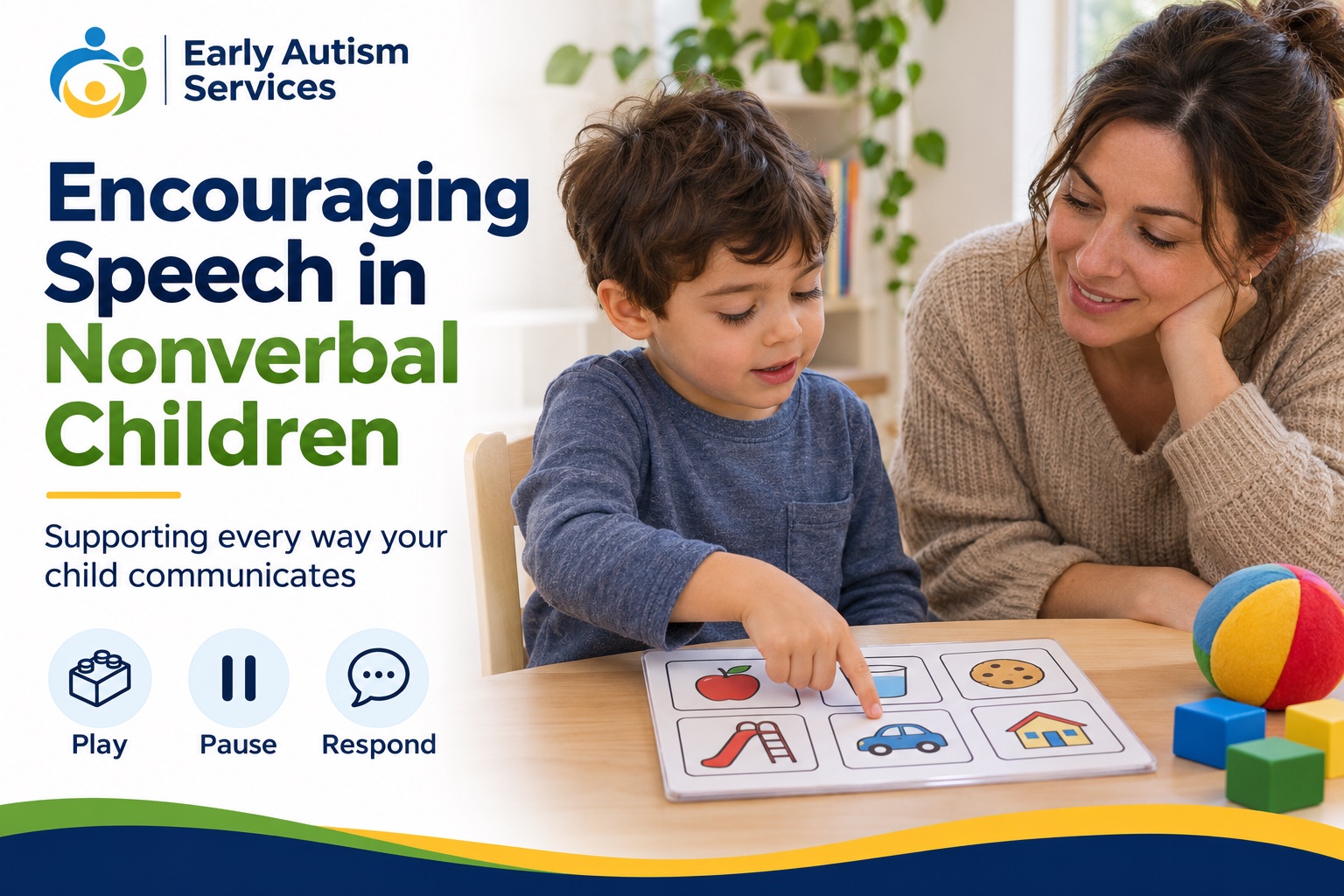
Encouraging Speech in Nonverbal Children
When a child uses few or no spoken words, parents often want to know what they can do to help. Encouraging speech in nonverbal children begins with understanding how the child already communicates and making those messages easier to express and understand.
Some families use “nonverbal,” while others prefer “nonspeaking” or “minimally speaking.” These terms describe speech use; they do not tell us everything about a child's understanding or ideas. The practical goal is reliable communication, with support for speech development when it fits the child's needs.


School Readiness Skills for Children with Autism
School readiness skills help children take part in the routines, relationships, and learning opportunities of the school day. For a child with autism, useful goals might include asking for help, recognizing a familiar routine, or becoming comfortable using a communication system with a new adult.
Readiness is not a pass-or-fail checklist. Children enter school with different abilities and support needs. The American Academy of Pediatrics emphasizes that schools need to be prepared for children at different levels of development, including children with disabilities. [1]
Families can practice useful skills while working with the school to arrange the support their child needs now.


