Encouraging Speech in Nonverbal Children
When a child uses few or no spoken words, parents often want to know what they can do to help. Encouraging speech in nonverbal children begins with understanding how the child already communicates and making those messages easier to express and understand.
Some families use “nonverbal,” while others prefer “nonspeaking” or “minimally speaking.” These terms describe speech use; they do not tell us everything about a child's understanding or ideas. The practical goal is reliable communication, with support for speech development when it fits the child's needs.
Start with an individualized communication assessment
A speech-language pathologist, or SLP, can assess how a child understands and expresses language, uses sounds and gestures, and participates in everyday interactions. Ask about a hearing evaluation as part of understanding communication difficulties. The National Institute on Deafness and Other Communication Disorders describes hearing assessment and speech-language evaluation as relevant parts of this process. [1]
Bring examples from home. Does your child point toward a cupboard, guide you to a toy, make a particular sound, or use a picture? Describe both successful communication and moments when messages are missed.
If your child loses communication skills they previously used, contact their healthcare professional promptly rather than waiting for home practice to help.
Notice and respond to existing messages
Observe what happens before and after a communication attempt. A child who gives you a closed container may be requesting help. You can respond, “Open,” and open it.
Responding gives the interaction a clear result. It also lets you model language connected to what matters in that moment. You do not need to ask for a repeated word before helping.
Try keeping a short note of the messages your child communicates most often and the ways they express them. Share it with other caregivers so they can recognize the same signals.
Use short language during enjoyable activities
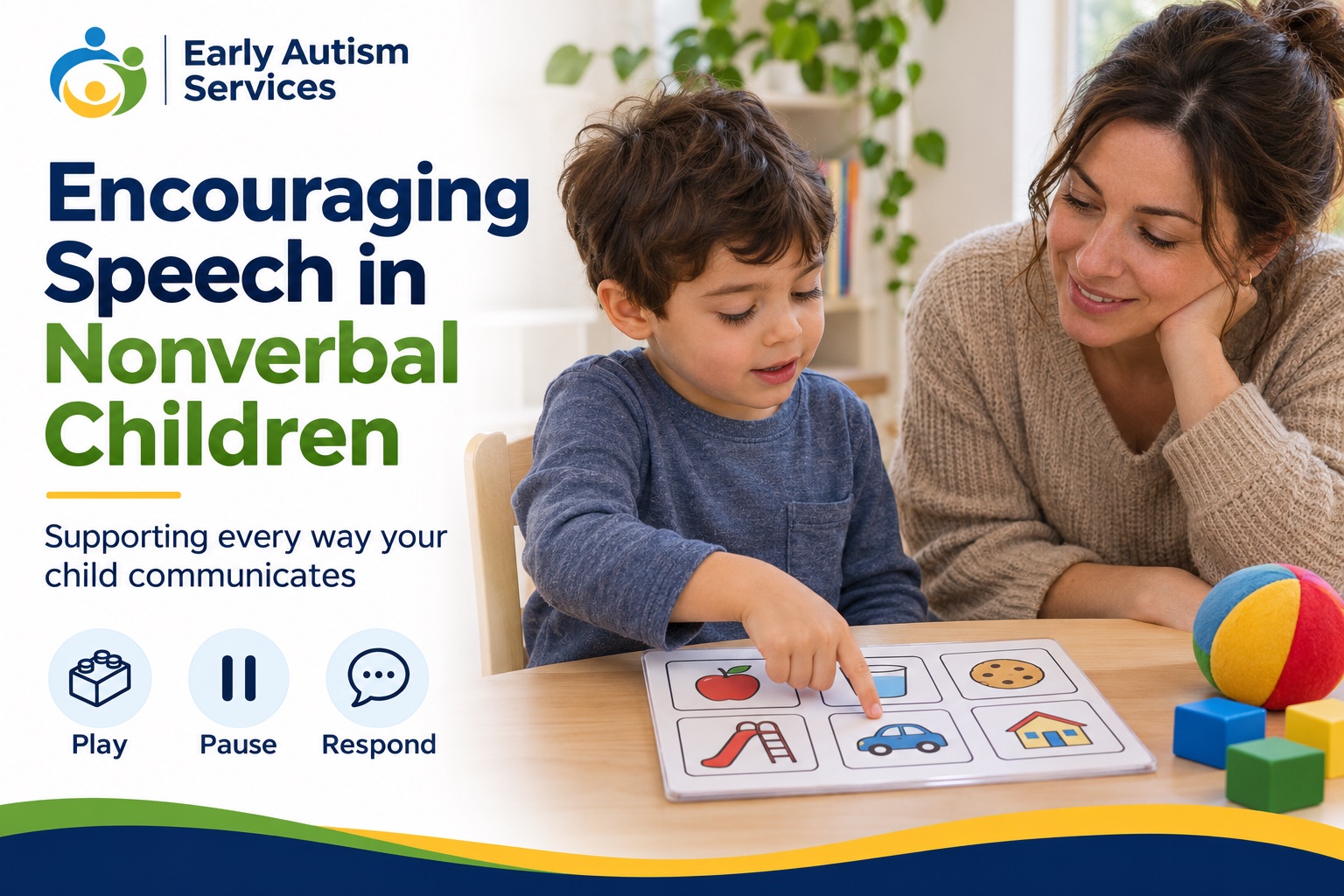
Choose an activity your child already enjoys, such as rolling a ball or building with blocks. Offer a short phrase that matches the action: “Ball rolls,” “up,” or “my turn.” Leave room for the child's response instead of talking continuously.
Your child might respond with a movement, sound, gesture, AAC selection, or word. Acknowledge the response and continue the interaction. Keep the activity enjoyable rather than turning each turn into a test.
An SLP can help you choose models that fit your child's current language and speech abilities. A strategy that works for another child may need adjustment for yours.
Allow time without creating pressure
After a comment or an invitation to take a turn, pause. ASHA describes waiting and pausing as a way to give young children time to process and respond through sounds, gestures, looks, or actions. [2]
Watch for signs that the child wants to continue, needs help, or is finished. If a pause becomes frustrating, offer support and move on. Food, water, comfort, and access to communication should not depend on producing a spoken word.
Avoid repeatedly asking the child to “say it” before responding to a message they have already communicated clearly.
Introduce AAC alongside speech support
Augmentative and alternative communication, or AAC, can include gestures, pictures, writing, communication boards, and speech-generating devices. An individualized assessment helps identify accessible options. [3]
AAC can be used while a child works on speech. The American Academy of Pediatrics explains that introducing augmentative communication does not prevent a child from learning to talk. [4]
For example, a child might select “outside” on a device while an adult says the word and prepares to go out. The message is successful whether or not the child repeats it aloud. Keep the communication system available across the day and learn how to model it with professional guidance.
Build consistent support across people and places
Agree on a small set of useful messages with the child's SLP and other team members. These might include requesting help, refusing, commenting, or expressing discomfort.
Use the agreed approach during ordinary routines and let the child communicate for different purposes. A system that only allows requests for snacks or toys may miss opportunities to share an interest or ask someone to stop.
If your child receives ABA therapy, ask how the provider will coordinate communication goals with the SLP, with your permission. Speech-language therapy and ABA have different professional roles and should not be treated as interchangeable services.
Recognize progress beyond the first word
Progress can include initiating an interaction, using a clearer gesture, selecting a message independently, or repairing a misunderstanding. Spoken language may develop differently for each child, and no home activity or therapy can guarantee speech.
Families can explore individualized ABA services through Early Autism Services while seeking speech-language guidance for speech and AAC needs. Ask your local team how goals can support your child's everyday communication.
Frequently asked questions
Will using a communication device stop my child from speaking?
AAC does not need to be withheld while a child works on speech. It can support communication alongside speech-language intervention.
Should I insist on eye contact before helping my child?
Make communication accessible through the child's preferred methods. You can respond to a clear message without requiring eye contact or a spoken imitation.
How can I tell whether home practice is useful?
Look for easier communication, more independent messages, and enjoyable participation. Discuss frustration or a lack of progress with the SLP so the approach can be adjusted.
Related reading
- How ABA Therapy Supports Non-Vocal Children with Autism
- Speech Delay vs. Autism: Understanding the Differences
Sources
[1] National Institute on Deafness and Other Communication Disorders — Communication Problems in Children with Autism.
[2] ASHA — Waiting and Pausing.
[3] ASHA public information — Augmentative and Alternative Communication.
[4] American Academy of Pediatrics — Speech Language Therapy for Children with Autism.
Explore More
Encouraging Speech in Nonverbal Children
When a child uses few or no spoken words, parents often want to know what they can do to help. Encouraging speech in nonverbal children begins with understanding how the child already communicates and making those messages easier to express and understand.
Some families use “nonverbal,” while others prefer “nonspeaking” or “minimally speaking.” These terms describe speech use; they do not tell us everything about a child's understanding or ideas. The practical goal is reliable communication, with support for speech development when it fits the child's needs.


School Readiness Skills for Children with Autism
School readiness skills help children take part in the routines, relationships, and learning opportunities of the school day. For a child with autism, useful goals might include asking for help, recognizing a familiar routine, or becoming comfortable using a communication system with a new adult.
Readiness is not a pass-or-fail checklist. Children enter school with different abilities and support needs. The American Academy of Pediatrics emphasizes that schools need to be prepared for children at different levels of development, including children with disabilities. [1]
Families can practice useful skills while working with the school to arrange the support their child needs now.


