Speech Delay vs. Autism: Understanding the Differences
Speech delay and autism can share some similarities, but they are not the same. This parent-friendly guide explores key differences in communication, social interaction, play, repetitive behaviors, and sensory needs, along with signs to watch for and when to consider a professional evaluation.
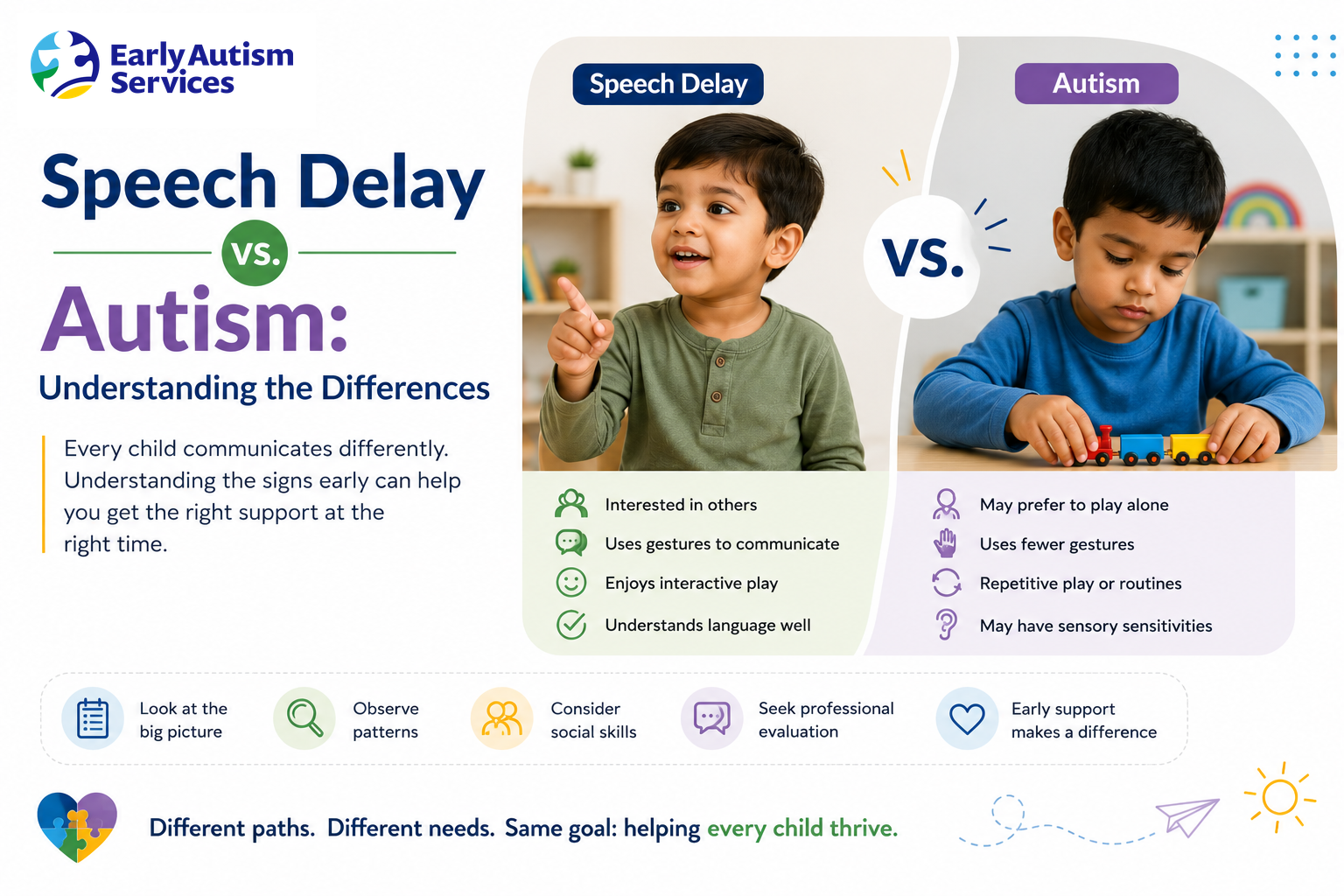
It's natural for parents to compare their child's development with milestones or other children their age. When a toddler isn't speaking as expected, one of the first questions that often comes to mind is, "Is it just a speech delay, or could it be autism?"
While speech delay and Autism Spectrum Disorder (ASD) can sometimes share similar signs, particularly delayed language development, they are not the same condition. A child with a speech delay may primarily struggle with communication, while a child with autism typically experiences differences in communication, social interaction, and behavior.
Understanding these differences can help parents know when to seek professional guidance and ensure their child receives the support they need.
In this guide, we'll explain the key differences between speech delay and autism, common signs to watch for, and when it's time to seek an evaluation.
What Is a Speech Delay?
A speech delay occurs when a child develops speech and language skills more slowly than expected for their age. This may affect how they pronounce words, build sentences, or express themselves.
Children with a speech delay generally understand language well and are interested in communicating, even if they have difficulty speaking.
Speech delays can happen for many reasons, including:
- Hearing difficulties
- Developmental language disorders
- Oral-motor challenges
- Premature birth
- Limited language exposure
- Other developmental conditions
Importantly, a speech delay alone does not automatically indicate autism.
What Is Autism Spectrum Disorder (ASD)?
Autism Spectrum Disorder is a neurodevelopmental condition that affects how a person communicates, interacts socially, and experiences the world.
While delayed speech can be one sign of autism, children with ASD often show differences beyond language, including social communication, play, sensory processing, and repetitive behaviors.
Every autistic child is unique, and signs can vary widely from one individual to another.
Key Differences Between Speech Delay and Autism
Although both conditions may involve delayed language, there are several important distinctions.
1. Social Interaction
Children with a speech delay usually enjoy interacting with others.
They often:
- Smile at caregivers
- Make eye contact
- Respond to their name
- Enjoy playing with family members
- Use facial expressions to communicate
Children with autism may:
- Have limited eye contact
- Respond inconsistently to their name
- Prefer playing alone at times
- Have difficulty understanding social cues
- Show less interest in shared attention or social games
Social communication differences are often one of the earliest indicators of autism.
2. Communication Style
A child with a speech delay may struggle to express themselves verbally but typically uses other ways to communicate.
For example, they may:
- Point to objects
- Wave goodbye
- Nod or shake their head
- Use facial expressions
- Attempt to communicate through gestures
Children with autism may have difficulty using both verbal and nonverbal communication.
Some children may:
- Rarely point to share interest
- Use fewer gestures
- Repeat words or phrases (echolalia)
- Have unusual speech patterns
- Find conversations challenging
3. Play Skills
Children with a speech delay often engage in imaginative or pretend play appropriate for their age.
For example, they may:
- Pretend to feed a doll
- Drive toy cars around a track
- Act out everyday routines
Children with autism may:
- Show limited pretend play
- Prefer repetitive play patterns
- Focus intensely on specific toys or parts of toys
- Line up objects repeatedly
Not every autistic child plays this way, but differences in play can provide important clues.
4. Repetitive Behaviors
Repetitive behaviors are generally not a defining feature of speech delay.
However, children with autism may display:
- Hand flapping
- Rocking
- Spinning objects
- Repeating routines
- Strong resistance to changes
- Highly focused interests
These behaviors are considered part of the broader autism profile.
5. Sensory Sensitivities
Children with speech delays usually do not have significant sensory challenges.
Children with autism may be especially sensitive—or less responsive—to:
- Loud noises
- Bright lights
- Certain fabrics
- Food textures
- Smells
- Physical touch
Sensory differences vary greatly from child to child but are common in autism.
Similarities Between Speech Delay and Autism
It's important to remember that both conditions can involve:
- Delayed first words
- Difficulty forming sentences
- Challenges expressing needs
- Frustration when communicating
- Need for speech-language support
Because these similarities exist, a comprehensive evaluation is essential rather than relying on speech alone.
Can a Child Have Both Speech Delay and Autism?
Yes.
Many autistic children also have speech or language delays, particularly during early childhood.
However, not every child with a speech delay has autism.
This is why healthcare professionals look at a child's overall development, including communication, social interaction, play, behavior, and sensory responses, rather than focusing only on speech.
When Should Parents Be Concerned?
Every child develops at their own pace, but it's worth discussing concerns with a healthcare professional if your child:
- Doesn't babble by around 12 months
- Doesn't use meaningful words by around 16 months
- Has very few words by age 2
- Stops using words or loses previously learned skills
- Doesn't respond consistently to their name
- Rarely points or gestures
- Avoids eye contact
- Shows repetitive behaviors
- Has difficulty interacting with others
Early evaluation can help identify the underlying cause and guide appropriate support.
How Are Speech Delay and Autism Evaluated?
If there are concerns about your child's development, professionals may recommend:
- Developmental screening
- Hearing assessment
- Speech and language evaluation
- Autism-specific assessment
- Observation of play and social interaction
- Parent interviews and developmental history
A team of professionals, including pediatricians, speech-language pathologists, psychologists, and developmental specialists, may work together to understand your child's strengths and needs.
The Importance of Early Intervention
Whether a child has a speech delay, autism, or another developmental difference, early intervention can make a meaningful difference.
Support may include:
- Speech-language therapy
- Occupational therapy
- Behavioral interventions when appropriate
- Parent coaching
- Early childhood educational programs
The earlier children receive individualized support, the greater the opportunity to build communication, social, and daily living skills.
Supporting Your Child at Home
Parents play an important role in encouraging communication.
Simple strategies include:
- Talk frequently during everyday activities.
- Read books together every day.
- Respond positively to all communication attempts.
- Encourage turn-taking during play.
- Limit passive screen time when possible.
- Celebrate progress, no matter how small.
Every child learns differently, and consistent encouragement can help build confidence over time.
Final Thoughts
Understanding the differences between speech delay vs. autism can help parents recognize when additional support may be needed. While both conditions can involve delayed language development, autism also affects social communication, behavior, and how a child interacts with the world around them.
If you have concerns about your child's development, trust your instincts and speak with your pediatrician or a qualified developmental specialist. Seeking an evaluation doesn't mean something is "wrong" with your child, it simply helps identify their unique strengths and the support that may help them thrive.
Early understanding, timely intervention, and a supportive environment can make a meaningful difference in helping every child reach their full potential.
Explore More
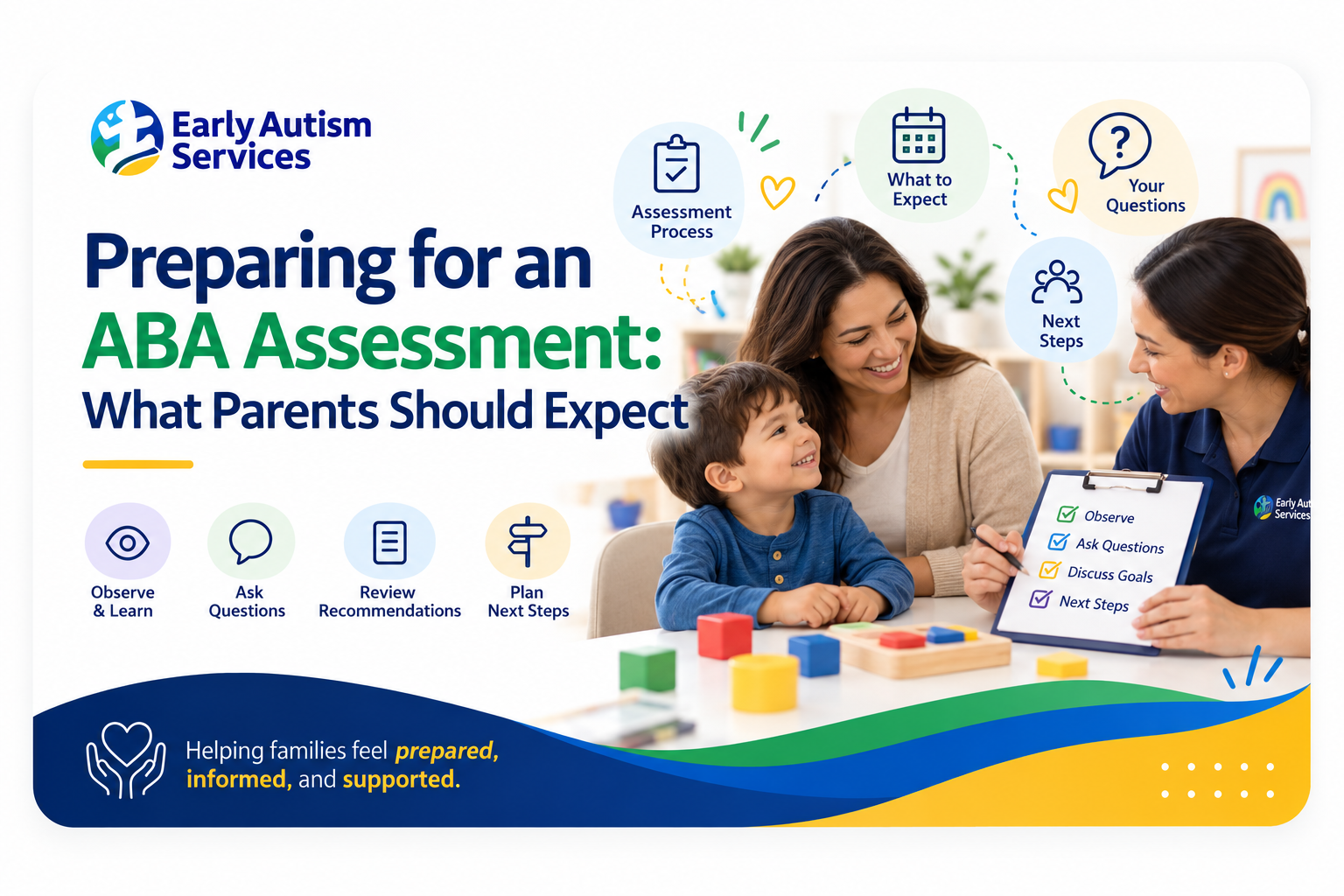
Preparing for an ABA Assessment: What Parents Should Expect
Accessing ABA therapy can feel overwhelming for families, especially when navigating service options, insurance, Medicaid, and the intake process. Early Autism Services works to make ABA therapy more accessible by offering different service settings, supporting families through insurance and intake, and providing individualized care based on each child’s needs.

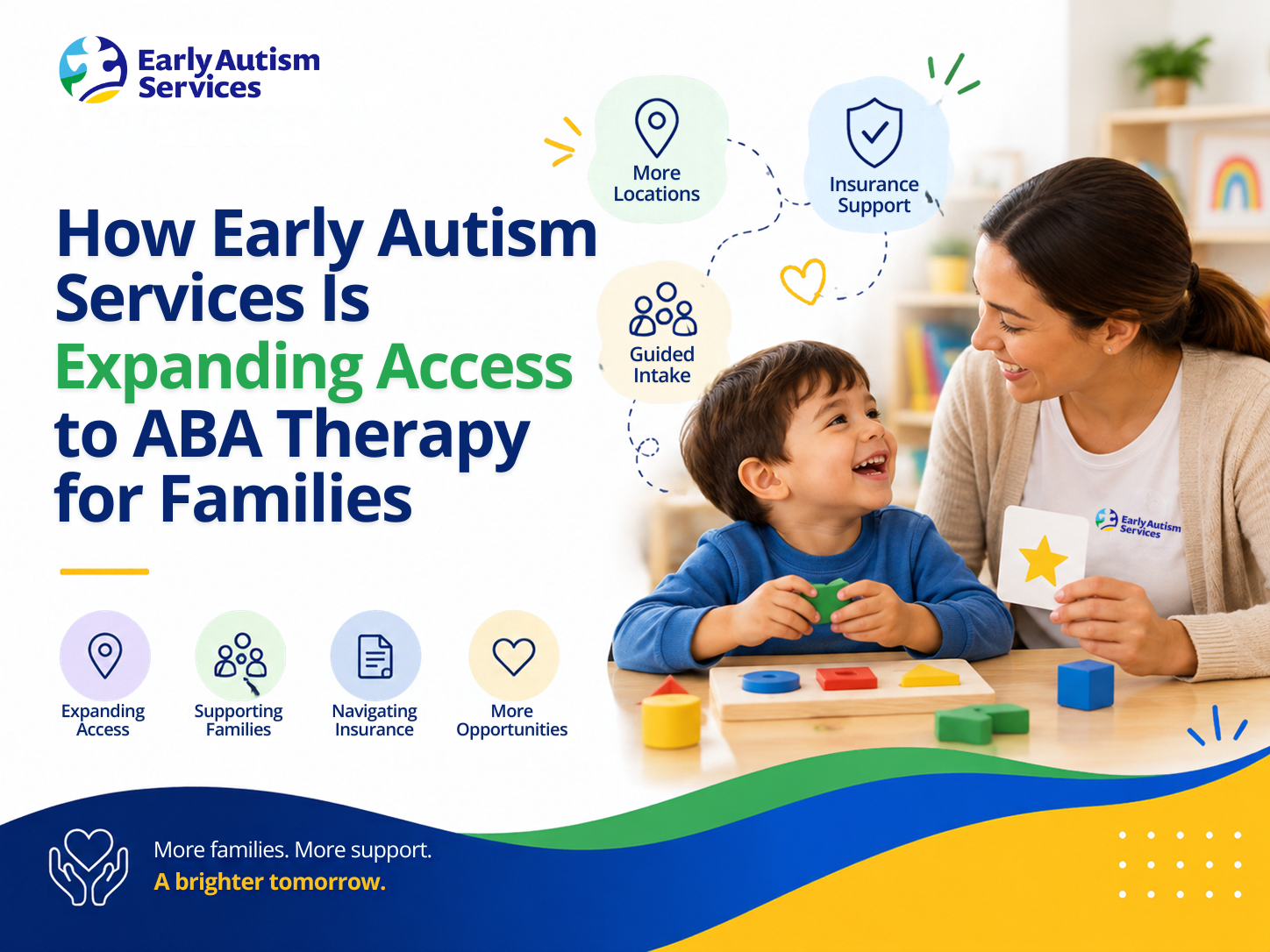
How Early Autism Services Is Expanding Access to ABA Therapy for Families
Accessing ABA therapy can feel overwhelming for families, especially when navigating service options, insurance, Medicaid, and the intake process. Early Autism Services works to make ABA therapy more accessible by offering different service settings, supporting families through insurance and intake, and providing individualized care based on each child’s needs.

Behavior Is Communication: Understanding What Your Autistic Child May Be Telling You
Behavior can be an important form of communication, especially when a child cannot easily express their needs in words. This parent-friendly guide explores what an autistic child’s behavior may be communicating, how to recognize possible triggers and patterns, and supportive ways to build functional communication skills.


